
Beyond the Mirror: The Evidence-Based Science of Elite Stage Presentation
Jul 09, 2026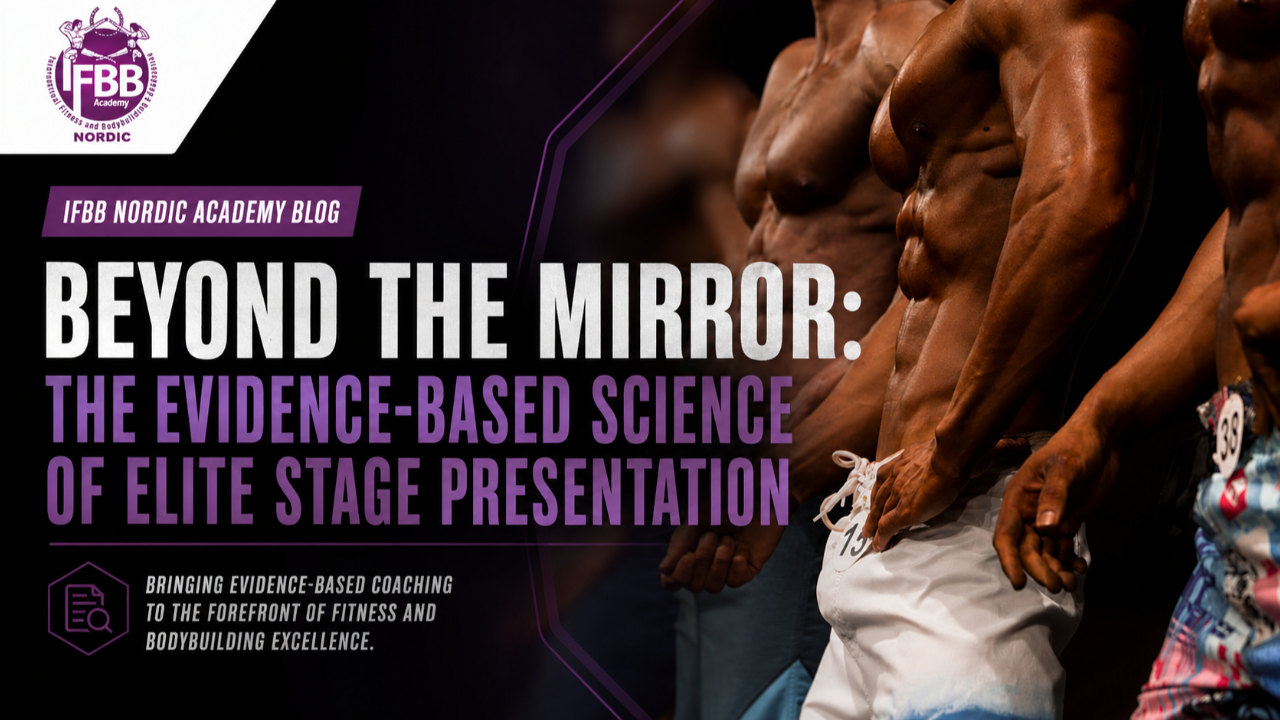
Beyond the Mirror: The Evidence-Based Science of Elite Stage Presentation
Discover how motor learning science and metabolic conditioning separate amateur posers from IFBB Elite Champions.
Evidence-based stage presentation
What is the biggest misconception about bodybuilding posing? Many believe that posing is merely standing still and smiling. This illusion—that stage presentation is a passive aesthetic display—leaves countless competitors woefully unprepared for the stage (Peixoto et al., 2024). In reality, bodybuilding posing is a highly complex, active motor skill requiring the concurrent integration of balance, breathing, and precise skeletal rotation under extreme conditions (Kind & Helms, 2023). The consequence is clear: in close matchups, skilled posers consistently beat athletes with superior physiques who cannot adequately display their hard-earned muscle.
The Metabolic Reality: Is Posing a Workout?
Posing is not cardiorespiratory rest; it is vigorous exercise. Laboratory data confirms that a single bodybuilding posing session meets the formal threshold for vigorous-intensity exercise. It operates at approximately 6.0 METs (Metabolic Equivalents) and pushes athletes to ≥77% of their maximum heart rate (HRmax) (Peixoto et al., 2024). Repeatedly holding 30–60 second maximum isometric contractions of major muscle groups surges the rating of perceived exertion (RPE) and cardiac output with each successive comparison round.
The Over-Coaching Trap: Why Verbal Cues Fail
Endless verbal corrections do not create better posing. Shouting internal cues like "shoulders back," "flare your lats," or "tighten your glutes" forces an internal focus of attention (Wulf, 2013). This conscious attempt to micro-manage automatic muscle groups triggers the Constrained Action Hypothesis, leading to high muscular co-contraction, structural stiffness, and visible anxiety on stage (Kal et al., 2013; Wulf, 2013).
While verbal cues might improve immediate performance in your presence, they severely degrade long-term motor learning when the athlete stands alone under the stage lights (Soderstrom & Bjork, 2015).
Stop Correcting. Start Constraining.
Elite posing coaches don't talk their athletes into position; they design the environment. According to ecological dynamics, movement is an emergent property of the interaction between the athlete, the task, and the environment (Soderstrom & Bjork, 2015).
How do you fix posing mistakes without talking? Introduce physical task constraints. For example, use light resistance bands around the wrists to implicitly force lat engagement, or utilize physical barriers to block spinal over-rotation (Helms, 2017; Helms, 2020). Task constraints bypass conscious verbal processing, allowing the athlete's nervous system to self-organize and discover deeply stable, automatic movement patterns.
Breaking the Mirror Dependency in Posing
Your athlete looks great in front of the mirror, but they may look completely different without it. Practicing exclusively in front of a mirror creates a high level of visual dependency (Helms, 2020). Remember: on the competition stage, there is no mirror.
If the athlete has not successfully transitioned from visual feedback to internal proprioceptive maps, their alignment and balance will drift under pressure. Elite stage coaching requires a systematic transition: from visual mirrors, to delayed video feedback, and finally to blind proprioceptive holds under physical fatigue (Helms, 2020; Soderstrom & Bjork, 2015).
Contextual Interference: Random vs. Block Practice
Block practice builds false confidence; random practice builds champions. Having a bodybuilding athlete hold the exact same front pose for 10 minutes straight is a low-retention strategy (Zourdos, 2020). The evidence-based approach is to implement contextual interference by heavily randomizing their posing practice.
Force your athletes to step out, move, turn, and reset their poses dynamically from entirely different angles. This constant physical reconstruction forces the motor nervous system to "relearn" the pose with every rep, leading to superior memory retention and unbreakable stage stability when the head judge unexpectedly shuffles the lineup (Soderstrom & Bjork, 2015; Zourdos, 2020).
4 Practical Applications for Posing Coaches & Athletes
Condition for the stage
Integrate full posing rounds into cardio or post-workout routines. Prepare the body to handle 6.0 METs and ≥77% HRmax exertion.
Utilize physical constraints
Stop over-verbalizing. Use physical tools like resistance bands to create boundaries that naturally guide the athlete into the correct posture without conscious thought.
Phase out the mirror
Dedicate the final weeks of contest prep to "blind" posing. Use internal feeling and delayed video feedback to build crucial proprioceptive awareness.
Randomize your practice
Ditch 10-minute static holds. Practice unpredictable transitions, quarter turns, and varied judge callouts to deeply ingrain motor patterns.
Want to dive deeper into posing science? Download the free 8-page guide: Why Better Posing Requires Better Skill Training →
Not sure which IFBB certification is right for you?
Start with the free IFBB Fitness & Bodybuilding Coaching Fundamentals Course.
Experience real IFBB Nordic Academy lessons, learn the foundations of training, nutrition, recovery and coaching, complete the final assessment and receive your Certificate of Completion.
No previous coaching experience required. Start free and discover your next education pathway.